Photo: Dietmar Rabich, CC BY-SA 4.0, via Wikimedia Commons
On the evening of November 9, 1989, an East German official named Günter Schabowski told a press conference that new travel rules would take effect immediately. That wasn't quite what the government had planned, and the confusion that followed is still one of the best stories in modern European history. By late that night crowds had gathered at the Bornholmer Strasse crossing, the guards opened the gate, and East Berliners walked into the West.
Thirty-seven years later, the Wall is mostly gone. Berliners and souvenir hunters chipped away at it, and the city demolished most of the rest within a couple of years. What survives is scattered, and if you don't know where to look you can cross its old route a dozen times without noticing.
That's a shame, because the surviving pieces are some of the most affecting places I know of in Europe. This is how I'd see them.
Start at Bernauer Strasse
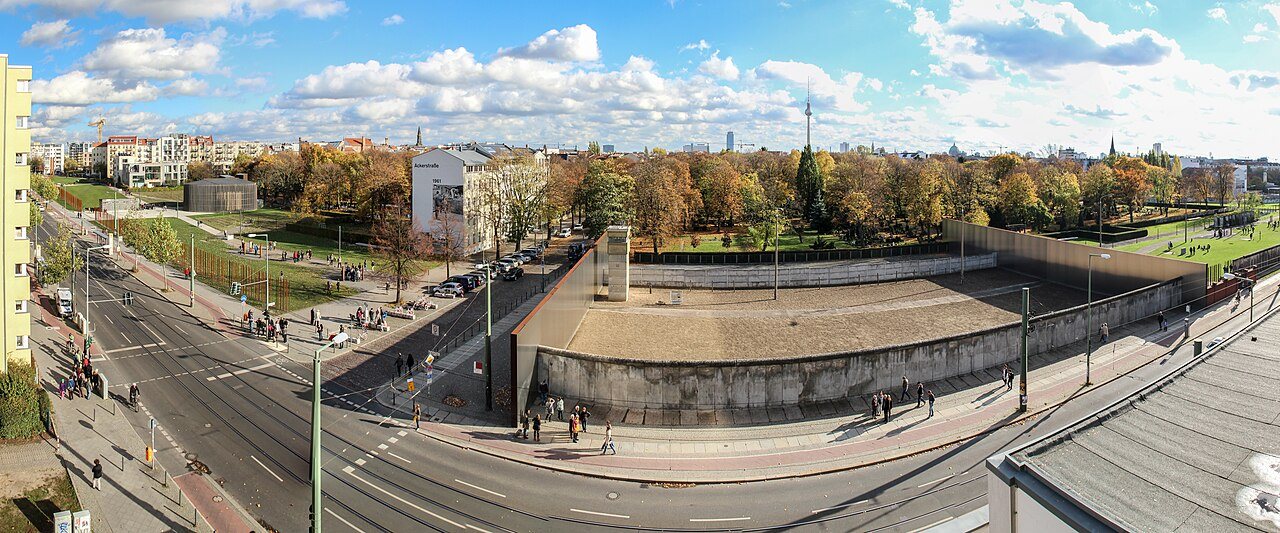
The Berlin Wall Memorial on Bernauer Strasse is the place to start, and if you only have a morning, it's the one to see. The memorial runs for about 1.4 kilometers along the street where the border cut straight through a neighborhood. In 1961 the buildings on one side were in the East while the pavement out front was in the West, and the early, desperate escapes from upper windows happened here.
What makes it work is that it shows the whole border system, and the wall was only one layer of it. One section keeps the full depth of the death strip: the inner wall, the raked sand, the patrol road, the lights and a watchtower. There's a viewing platform at the documentation center across the road where you can look down on it, and that view explains more in thirty seconds than any diagram. The open-air grounds are free to walk.
Take your time with the outdoor exhibits along the way. Steel rods mark where the Wall stood, and markers on the ground show the routes of escape tunnels dug under the street. The Chapel of Reconciliation stands on the site of a church that sat inside the border strip and was blown up in 1985. The nearest S-Bahn stop is Nordbahnhof.
The East Side Gallery and its paintings
The East Side Gallery, along Mühlenstrasse by the River Spree in Friedrichshain, is the longest surviving stretch of the Wall at more than a kilometer. Artists from many countries painted it in 1990, and some of the images, like Dmitri Vrubel's painting of Leonid Brezhnev kissing Erich Honecker, have become postcards in their own right.
It's a cheerful place, which can feel strange, and that's partly because of which side you're seeing. The painted side faced East Berlin, and before 1990 it was the side ordinary people could not get anywhere near. Walk around to the riverbank side too. Ostbahnhof and Warschauer Strasse stations are each a short walk away.
Go early if you can. By late morning the most famous panels have a queue of people waiting to take the same photo.
Checkpoint Charlie and the Palace of Tears
Checkpoint Charlie, on Friedrichstrasse, was the best-known crossing point for foreigners and Allied personnel, and the scene of the 1961 tank standoff between American and Soviet forces. The guardhouse you see today is a replica, and the area around it is about as touristy as Berlin gets. I'd look, read the outdoor panels and keep moving.
A few minutes away, the Tränenpalast (Palace of Tears) at Friedrichstrasse station is far more moving. It was the departure hall where East Berliners said goodbye to visiting relatives from the West, which is how it got its name. It now holds an exhibition about the border and everyday life around it, and in my view it gets much less attention than it deserves.
Follow the cobblestones
Through the center of the city a double row of cobblestones set into the street marks where the Wall once ran. You'll spot it near Potsdamer Platz and close to the Brandenburg Gate, often with small plaques reading "Berliner Mauer 1961-1989." Once you've noticed it, you'll keep noticing it, and it's an odd feeling to step over a line that people died trying to cross.
If you want more, the Berlin Wall Trail (Berliner Mauerweg) follows the former border around the whole of West Berlin for roughly 160 kilometers, much of it on bike paths. You don't need to do all of it. A section by bike on a clear day, out toward the edges of the city, shows how much of the border ran through woods and fields rather than streets.
Why November 9 is complicated in Germany
If you're in Berlin on November 9, you'll notice the date has more than one meaning. It's also the anniversary of the Kristallnacht pogrom of 1938, when Nazi-organized mobs attacked Jewish homes, businesses and synagogues across Germany. Germans sometimes call November 9 a "day of fate" for that reason. It's one of the reasons Germany's national holiday is October 3, the date of reunification in 1990, rather than the night the Wall opened.
You may see commemorations for both on the same day. Be respectful of them.
Planning a Wall day in November
November in Berlin is usually gray and cold, and it gets dark early, well before 5 p.m. That changes the plan. Do the outdoor sites, Bernauer Strasse and the East Side Gallery, in the morning and early afternoon, and leave the indoor exhibitions for later. Wear proper shoes, because you'll walk more than you expect.
A sensible order is Bernauer Strasse first, then the S-Bahn into the center for the Tränenpalast and Checkpoint Charlie, then the East Side Gallery late in the day if the light holds. Opening hours for the indoor exhibitions change by season, so check the official sites before you go. And if you have an extra day, the Stasi Museum in Lichtenberg is worth the trip if you want to see the secret police headquarters that kept watch on the people behind the Wall.
See more of us on GoogleAdd TrueVoyager as a preferred source and our stories can show up more often for you in Top Stories.